Toxic Treadmill
Capitalism as 'Bad' Eugenics
How dysgenic capitalists create dystopia
An explicit link between eugenics and capitalism is found at least as far back as 1933, when eugenics was in fashion. The original aim of eugenics was to cultivate, and encourage, a happier human race. However, it was an ignorant and badly considered movement resulting in the 'bad' eugenics that eugenics is often understood to mean. Eugenics isn't always conducted through the forceful violence associated with it, but through systems that dominate thought and behaviour.
Capitalism isn't merely an economic system, but a cultural and social framework that establishes norms, values, and goals. It valorizes the pursuit of financial success and materialist goals, making them indicators of virtuous behaviour. In this context, success is measured primarily by one's ability to outcompete others in resource acquisition and wealth accumulation; a questionable ethic that is celebrated, despite its potential to undermine social cohesion and morality. By promoting competitive, self‐focused behaviours over caring and collaborative dispositions, and prioritizing socio‐economic pressures, a hegemonic environment is created that favours certain genetic traits that are predetermined by biological reality. As such, the system functions as a form of cultural eugenics, and is therefore incapable of producing just or meritocratic outcomes. I'll explain why.
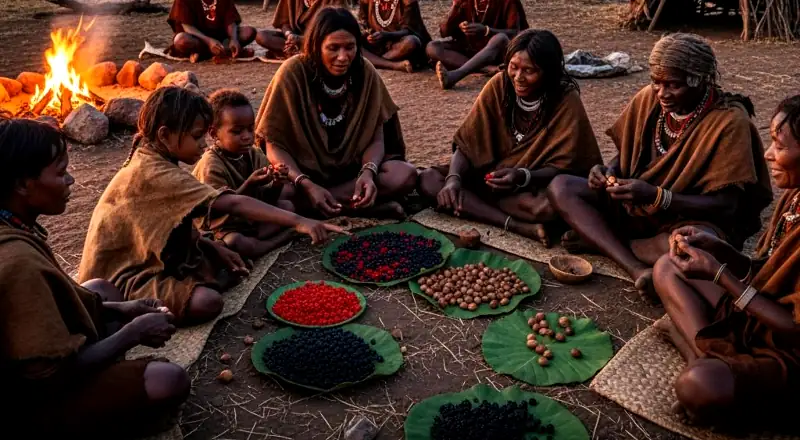
Capitalist societies are built on an ideology that promotes competition, and self-enrichment, as signs of personal merit and social success. They are imbued a quasi‐virtuous significance; the ability to make financial gains, and secure and control resources, is celebrated as a mark of individual excellence and virtuous self‐reliance. This redefinition of success has its roots in historical shifts. Early hunter-gatherer societies were often egalitarian, and had norms favouring cooperation and shared resources. Their revered leaders, if they had any, were wise elders. People with experience and knowledge of how to maintain social cohesion and care for the whole tribe. In a fairly short space of time, complex agricultural and industrial societies emerged with more permanent abodes and political structures. This enabled resource accumulation, which also became the driver of social differentiation and class, or caste, systems. While leaders enjoyed a near god-like status, they similarly promoted the cultural ideal of 'working hard' and making sacrifice of one's labour, and one's produce, to a god head of some sort. This system was administered by a priesthood who benefited immensely from the deal, their invisible gods less so. The essence of such arrangements is very similar to those in contemporary Western society. However, the religious virtuosity of work distracts from the ruthless practices that underpin capitalist markets, masking exploitative and unethical behaviours under the guise of individual merit.
Human behaviour is significantly modulated by genetic and biological factors that are predetermined for each individual, not chosen. In capitalist environments, particular personality traits have been found to confer competitive advantages including power-seeking, dominance, and strategic self-promotion. Empirical research, and evolutionary psychological theories, indicate that traits aligned with the 'control and hold' strategy are more adaptive in systems that prioritize wealth accumulation and individual success. These traits, which include aspects of narcissism, Machiavellianism, and even psychopathy, are often correlated with the ability to navigate and exploit competitive environments effectively. In contrast, genetic predispositions associated with empathy, caring, and communal cooperation developed when cooperative resource sharing and mutual support were the dominant values. In capitalist contexts, these prosocial traits are systematically undervalued, as they do not directly contribute to strategies of resource monopolization or competitive ascent.
The interaction between societal norms and biological dispositions creates an environment in which the expression of certain traits is favoured while others are suppressed. Capitalism, by institutionalizing competition and valuing financial success over communal well-being, exerts a selection pressure on genetic profiles that supports aggressive, risk-tolerant, and self-serving characteristics. Over time, individuals with dispositions toward power-seeking, dominance, and effective resource hoarding may find themselves consistently rewarded, while those with traits such as empathy, sensitivity, and caring may experience relative disadvantage in terms of social recognition and economic opportunity. This selection process is part of a dynamic socio-epigenetic interplay where cultural norms and institutional structures influence gene expression and behaviour over successive generations. So, it's not only the genetic composition that forms the basis of an individual, but how the environment interacts with it, activating certain traits and disengaging others.
Among the most concerning consequences of the competitive ethos in capitalist societies is the encouragement of unethical behaviours stemming from relentless greed and an insatiable desire for growth, absent of any end goal. The same norms that elevate competitive success as a pseudo-virtue also provide cover for behaviours that are otherwise socially condemned, such as exploitation, tax evasion, environmental degradation, and the commodification of human relationships. In such systems, unethical practices are rationalized as necessary tactics for survival, rewarding those who are willing to engage in domination, control, and 'tough' or cut-throat practices. The normalization of unethical behaviour creates a feedback loop wherein individuals displaying 'dark triad' traits (narcissism, Machiavellianism, and psychopathy) become disproportionately successful in positions of power. These pathological traits then become markers of success. Consequently, the ethical standards of the wider society are destroyed. Such erosion can be seen in general discourse where pathological behaviour, suffering, and loudmouthed hostility are categorized as strong, and gentle intelligence, comfort, and caring behaviour, are vilified as weak. A culture where phrases like, 'He's a machine,' are used as lionizing compliments. These patterns tap into the basest level of survival driven cognition, creating a permanent state of mutual animosity and pervasive anxiety.

In contrast to the competitive, individualistic foundations of capitalist societies, alternative forms of socio-economic organization emphasize cooperation, sharing, and welfare as core values. In these systems, policies geared toward reducing economic inequality, and enhancing collective support, can create environments that nurture prosocial behaviours including empathy, caring, and solidarity. For example, historical developments in post-World War II welfare states—where regimes invested in public services like healthcare and education—demonstrate that when societal structures legitimize collective care and egalitarian norms, traits oriented toward empathy are more likely to be valued and reinforced. Such alternative systems often prioritize equity and social protection over unbridled competition, which can provide a counter-narrative to the pseudo-virtuous emphasis on financial success found in capitalist societies. In these environments, while competitive traits may still exist, there is a greater institutional support for behaviours that promote mutual aid and community resilience, potentially allowing individuals with stronger predispositions for caring and sensitivity to thrive socially and economically.
'Social eugenics' exists when conditions systematically favour individuals with certain genetic profiles. In this view, capitalist competition does not operate on the principle of explicit genetic manipulation, but rather through institutional and cultural mechanisms that elevate individuals with particular personality traits. Power-seeking, low empathy individuals become more prevalent among those who succeed, hence those with such traits have a higher level of influence on the values of society as a whole. This leads to a self-reinforcing system of values requiring increasingly extreme forms of immoral, Machiavellian behaviour to compete successfully.
Capitalism’s normative emphasis on competition, and its influence on the underlying genetic makeup of individuals, presents a complex dynamic. Research suggests that genetic variations, such as those influencing neurotransmitter systems like oxytocin and vasopressin, modulate tendencies toward prosocial vs. aggressive or dominant behaviours. In capitalist environments, individuals with genetic predispositions toward traits such as risk-taking, aggression, and strategic manipulation may be more likely to rise to positions of power and secure financial rewards. Conversely, those with genes that promote behaviours essential for enduring social bonds and group cohesion find their abilities to contribute to collective well-being underappreciated, or actively penalized. Some will become dysfunctional, others adapt by suppressing their harmonious potential, preferring to cultivate combative and self-centred ways. Caring and empathy then become performative; deceptive tools for achieving personal goals, rather than a means for creating existential value. In this way, the prevailing capitalist ethos shapes, at least in part, the behavioural gene expression of populations via epigenetic mechanisms, learned behaviour, and social reinforcement. The long-term implications for individual development, and societal stability, are likely to be extremely destructive and detrimental to the species as a whole. More properly, capitalist eugenics should be labelled capitalist dysgenics.
Empirical observations from welfare-oriented systems indicate that when collective well-being is prioritized over individual accumulation, social bonds are stronger and ethical behaviour is more integrated into everyday practices. Furthermore, in such settings, there is often greater institutional recognition of the value of public goods and community cohesion, which can mitigate the selective advantage of traits geared exclusively toward domination and wealth accumulation. The expression of genetic traits isn't always fixed, but rather contingent upon the socio-economic structures in which they are expressed. While capitalist systems might favour traits that support adversarial competition, more egalitarian and cooperative models enable individuals predisposed toward compassion and altruism to thrive, thereby contributing to a more inclusive and stable social fabric.

If the long-term survival of the species is considered a good thing, there must be greater emphasis on harmonious and peaceful social relations. This requires a continual conscious reform of socio-economic policies and cultural practices where care and empathy are recognized and valued above personal gain. Those who perceive such changes as a threat are likely to seek to control, subvert, or prevent them, using the most devious of methods. History shows that regardless of the expressed political ethos of those seeking power, the long-term results of a regime dominated by corrupt bullies is never good. Debating the intellectual value systems of philosophy or politics is incomplete without incorporating the chaotic, antagonistic nature of genes and biology. The power of the fundamental processes of the flesh must be understood, and it must be recognized that the subconscious whims of organisms have nothing to do with purpose, morality, meaning, or virtue.
References
Allaun, F. J. (1933). Eugenics and capitalism. The Eugenics Review, 24(4), 345.
Biglan, A., Lee, J., & Cody, C. (2015). The Evolution of Capitalism. The Wiley Handbook of Contextual Behavioral Science, 496-512.
George, J. M. (2014). Compassion and capitalism: Implications for organizational studies. Journal of Management, 40(1), 5-15.
Gilbert, P. (2021). Creating a compassionate world: Addressing the conflicts between sharing and caring versus controlling and holding evolved strategies. Frontiers in psychology, 11, 582090.
Grey, J. (2013). The ideology of capitalism. AmeriQuests, 10(1).